Imagine your favorite book but different.
No. Try again.
Nope.
Okay, that's not even a book.
Imagine if your favorite book were about a man in a tan jacket carrying a deerskin briefcase.
Closer.
That's good enough.
Imagine your favorite book but different.
No. Try again.
Nope.
Okay, that's not even a book.
Imagine if your favorite book were about a man in a tan jacket carrying a deerskin briefcase.
Closer.
That's good enough.
Writing can be an incredibly isolating and challenging task. It's hard to find help, and sometimes it's hard to even know where to look to find help. Sometimes, it's hard to even know what's good resource versus a bad one, and sometimes you don't even know what you don't know to even ask about! That last one seems to be the story of my life.
So, here I've compiled some of my favorite resources that I use on a regular basis and I think would be helpful for writers all along their journey, whether you're just starting out, published, lost, or just curious.

I downloaded a sample of PaperHearts with not an intention of buying it. I've read tons of writing advice books and wasn't keen on adding any more to my collection but then I read:
The first thing out of most people's mouths after you tell them you wrote a book is, "when will it be published?" Falcon punch these people in the throat and tell them to calm the heck down.
And I knew this was the kind of advice book I needed in my life.
I bought it and fell straight in to a book filled with some of the realest advice on writing I've ever seen. Revis is totally blunt about her struggles, about her numerous failed novels and exactly how much money she spent on her writing attempts. There are straight forward looks at what being a writer is like for someone before they break it big.
She also gives great advice on plotting (I love the three humps plot layout) that I cannot wait to try out in my novels. She's funny, irreverent and also very serious about her writing. I went ahead and bought her other Paper Heart books because I loved her tone. I didn't feel like she ever talked down, or made fun of anything. She's very clear on what works for her and that everyone has a different way of writing and that finding what works for you is an important part of writing.
It's rare that a writing advice book makes me laugh, but I giggled through a good part of the book. I highlighted and took notes. I alreayd know I'm going to be going back to reread this and I cannot wait. So far, out of all the books I've read on writing (a fair number of them at this point) Paper Hearts holds a spot at the top of the list because of the relatability of her words. It feels like I'm just having a conversation with Revis in the bar at a local convention; it's advice I can relate to and that I can actually impliment. She makes me feel not along in my struggles with writing, querying and finding my way in the wild world of publishing.
You can buy Paper Hearts here or order from your local Indie bookstore.
No writer has the same path to publication, and there is no right or wrong way to get published (aside from getting snagged up in a vanity press scam I'd say).
My path to my first publication begins in college. As a student studying creative writing I submitted to my college's literary magazine and ultimately ended up with two poems and a short story accepted and published before I graduated. I can still remember the total rush with that very first acceptance letter that sent my heart pounding. I could hardly believe the words and wanted immediatly to feel it again.
After I graduated, I kept submitting my work, but writing started to fall to the side as I struggled to find a job and a stable life outside of college. In 2011 I made a New Year's Resolution to focus more on my writing and decided to kick that off by attending a convention with what looked like a great set of panels about writing. In February I went to Connooga and attended almost every panel on writing. I met a lot of new friends and had an amazing time, learning and asking questions.
I went to a few more conventions with writing tracks that year and eventually got brave enough to ask one of the writers I'd met, Sean Taylor, to read over my work. He enjoyed my short story enough to recommend me to Pro Se Productions, a publisher looking for writers for a new character, The Pulptress. I accepted and fell in love with the character, and the world of pulp writing.
I learned a lot while working on my first story for The Pulptress collection. The biggest lesson was recovering from disastor when my drive corrupted and I lost 80% of my story and had to start over with the deadline on top of me. The editor, Tommy, worked closely with me on the story, and when the book came out I could hardly believe it was real. Me with my name in a book on Amazon!
Around this time I made the decision to hide on to graduate school for my MFA in Poetry. The Pulptress did well and I was approached about writing two standalone books about the characters I'd introduced. I couldn't say yes fast enough. Again I learned a lot of valuable lessons as I struggled to balance writing my first digest novel, The Bone Queen, with grad school. I dropped out of the MFA program and switched to an MA degree where I could spend more time researching. I got a dreadful stomach flu that knocked me out for nearly two weeks. Crisis hit, and I just barely turned in a draft ahead of the deadline.
And boy it was a bad draft!
Rather than tossing me out on my butt, Pro Se worked with me and together we came up with a digest novel I love. That digest novel wouldn't be what it is without all the time and effort Tommy put in with me and I'll always be insanely proud of it. The cover turned out incredible and for the first time, I really felt like an author. I sat on panels as a panelist. People asked me questions; people could buy my books at conventions. It was a dream come true.
The next digest novel went smoother as I learned more about writing under a deadline. I finished grad school, got a new job, moved, and found a routine. I sent out short stories, and started working on more projects. By the time my next digest novel, The Pulptress versus The Bone Queen, came out I felt more confident as a writer and had started to figure out myself as a writer.
Writing taught me a lot about myself, and a lot about how I operate. I've learned I'm tough and that I will do everything in my power to meet deadlines. I've learned how to take critiques and roll with them to make a better story. I'm still finding my voice, but I feel much more sure in it than I ever have before. While I've move into other genres, I'll always be thankful to the start the pulp, and Pro Se gave me. I wouldn't be the writer I am without the time working with some amazing editors and publishers.
It seems appropriate starting a new year by looking back at where I've come from as a writer and I'm amazed at how far I've come since just 2011. It's only been 5 years but I feel like an entirely new person.
Here's to seeing where 2016 takes my writing and my life!
Happy New Year!

Me with the first copy of The Pulptress!

Perfectionism is something I've struggled with for a long time. It's one of the things that keeps me from completing projects I know I'm capable of doing. It's easy to get caught up in the loop of everything has to be 100% perfect to leave your hands. Or, what's worse, to not even attempt something unless you know you can do it. Sticking with things you know is no way to grow.
I've read some from Stehpen Guise online and liked his work, but the title and premise of this book made it a must purchase for me. It's probably the kindle book I've most highlighted in and I find myself coming back to it just to read over sections I've highlighted. Any time I struggle with a new project, or with worrying something isn't good enough, I go back to this book.
The chapters are well organized into first a discussion of problems and then advice on practical solutions to move past these issues. One of the tips I've found most helpful is a simple reframing of how I think about the past. I tend to dwell on the past and worry about what I should have done differently. Guise's simple advice is to think 'I could have' instead of 'I should have'. That simple change in vocabularly makes it seems more like I made one of a dozen possible choices and not that I've been judged a failure.
These small but practical tips make conquering the challenge of perfectionism seem like a reasonable thing to do. As we start 2016, I think that this guide can give you a positive headstart into a new year and a new way of doing things.
You can buy How to be an Imperfectionist here or at your local Indie bookstore.
2015 has been a strange, but successful year. This year I've written just under 300,000 words. I finished three novel drafts, two short stories, and a lot of rambling to myself. 90,000 words were all written during this year's NaNoWriMo. All in all, I know I could have written more words this year, but life happened. I bought a house, lost several friends and made some big changes to better help steer me towards the future I want. I'm not disappointed in this year, but I am excited about next year. I know what I want to write. I know what I want to do and now I get the chance to actually make a move on those goals. If 2015 was my year of planning than 2016 is my year of action and I am so ready for it.
Read More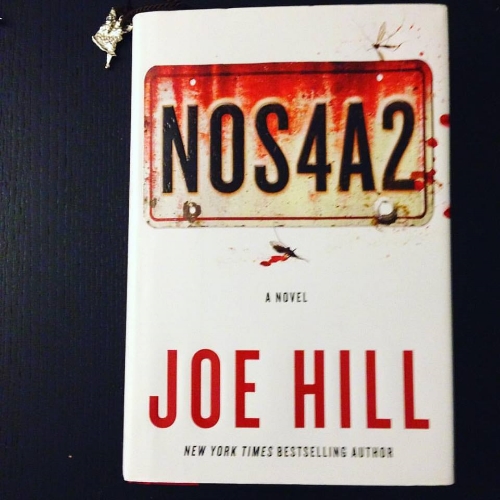
I've had this book on my radar for a long while. I've had friends recommend, and one friend literally hand me a copy to read. And yet, it sat in my to-be-read pile towering over me for months. Until, that is, I needed a Christmas themed book to review and wasn't having luck finding one I really enjoyed enough to review.
A friend casually pointed out that Christmas plays a big part in N0S4A2 and "oh by the way you've had my copy for months and need to read it so I can have it back." So I dove in without much clue what to expect.
The story is difficult to describe without it sounding a little batty. A killer, Manx, in a car that can take him and the children he's stolen to a magical world called ChristmasLand where unhappiness is forbidden. A girl, Vic, who can find things and go exactly where she needs to go by riding her bike across an old bridge that shouldn't exist. Their paths intersect when the bridge sends Vic straight to Manx' world and she ends his rampage for a time. Now Manx is back and out for revenge and Vic has to summon up her old bridge to find a way to stop the killer for good.
So, the novel is told through several points of view, most predominatly through Vic's point of view but there are several other points of view that you see the story through, victims, murderers, and witnesses to the strange. And even the very prose of the text mimics the jumping magic that Vic's bridge gives her. The text will cut off literally in the middle of a phrase and leap into the next chapter as Vic jumps from place to place with her bridge.
One of my favorite parts of the novel is the images in text and the clever use of text I've never seen before. Backwards sentences, vertical words and patterns across the page. I loved the playfulness of words, and the fact that scrabble tiles play a big role as well. There's a clear love of language here and I adore that.
We see Vic go from kid to grown woman who has to defend herself and her family from Manx on the prowl for revenge, all while she tries to find what's real and how to manage the real world. The lead up to the showdown tensed my whole body. I wasn't sure how in the world Vic was going to manage to win this showdown, and every time I turned the page things seemed to be getting worse and worse. Hill really turns the tension to 11 and leaves it there. Even after the final showdown is over there are lingering problems and I couldn't relax until the very last page when things had been answered.
Over all, it took me a bit of time to really get into N0S4A2. I tend to not jump into books with multiple points of view and the jumping povs and timeshifts took some adjusting to. But Hill tells a tightly wound story where I couldn't figure out what would happen next, and that kept me turning pages and diving into each character's chapter and towards the final showdown.
It certainly left a bit of dark, twisted look at what happens when Christmas joy goes very, very wrong. Manx' focus on all joy and not unhappiness leads to a twisted place where joy can be found even in horror. While Manx promises the children they are going to a place of wonder and magic, all they discover is a world where horrors give them joy and murder is the game of the season.
I'm not sure N0S4A2 is the best Christmas read for everyone but if you like horror, and your holidays a bit dark and twisted than curling up with some hot cocoa and a copy of Joe Hill's N0S4A2 might be the perfect way to pass Christmas day.
You can buy your copy of N0S4A2 here or at your local indie bookstore.
When I was in high school, I would fantasize about what my life would be like when I became a real writer. I'd have a fancy house and a live in chef so I could just write all day. Everything would be great and I'd have tons of free time to do anything else I wanted to. It'd be perfect. Now I want to throttle high school me for ever even thinking that.
Read More
When I started reading The Resurrectionst, I had to actually stop my reading and google who Dr. Spencer Black was. I thought he was a real person and I was fascinated. The book draws you in immediatly into the mind (and works) of Dr. Spencer Black, a man who took corpses from the grave to try to prove that the mythological creatures of legend were human ancestors.
Read MoreUntil very recently the idea of pitching an agent or an editor face to face was among the most terrifying things that could ever happen to me. I got flustered when readers asked me what my book was about let alone when I had to tell an agent or editor what my book is about. Talk about a freak out inducing moment.
Read More